

2026 Reality Check: Your Home Is Now Your Operating System
In 2026, “going to work” no longer means leaving home five days a week. For many people, work is split across home, office, cafés, client sites, and video calls. That shift changes what a “good home” means. It’s not just a place to sleep. It’s where you think, present, recover, and build momentum.
Here’s the trap: people still choose a home like it’s 2015 pretty photos, nice view, good promotion rate then discover the real problems later: noise that kills focus, harsh sunlight that turns your room into an oven, unstable internet, and electricity bills that quietly balloon. If you live the hybrid-work life, your home needs to support performance and recovery, not just look good.
This guide shows how to choose a condo or house that truly fits hybrid work in Thailand layout, light, noise, heat, neighborhood life, and the money plan that keeps you safe even if rates move.
The Hybrid-Work Home Formula: Stop Energy Leaks
A great hybrid-work home prevents four “energy leaks”:
Noise: Not just traffic hallway footsteps, elevator zones, mechanical rooms, construction cycles, weekend activities. Visit at different times, not just a quiet weekday afternoon.
Light: Natural daylight isn’t décor it’s productivity and sleep quality. You want usable daylight without screen glare, and a setup that doesn’t force you to live under artificial lighting all day.
Heat: Thailand punishes poor orientation and weak heat protection. A room that bakes in afternoon sun will cost you in comfort and electricity. And electricity tariffs can change by period; Thailand’s Ft adjustments and published updates show that energy costs are not “fixed forever.”
Rhythm: Hybrid work collapses boundaries. If your bed becomes your desk, your brain never fully shuts down. Your home should help you separate “work mode” from “rest mode,” even in small spaces.
Condo vs House for Hybrid Work: The Practical Trade
A condo can be perfect if you value time and convenience: less commuting, easier maintenance, shared amenities, and better access to the city. But you must manage noise, limited storage, and layout constraints.
A house can be perfect if you need space, flexibility, or a true separate workroom especially for families or people with lots of gear. But you’ll pay with maintenance, possible longer commutes, and higher cooling costs if orientation and airflow are poor.
Hybrid work changes the equation: a “cheap but far” home can become expensive once you price in time, transportation, stress, and daily energy use.
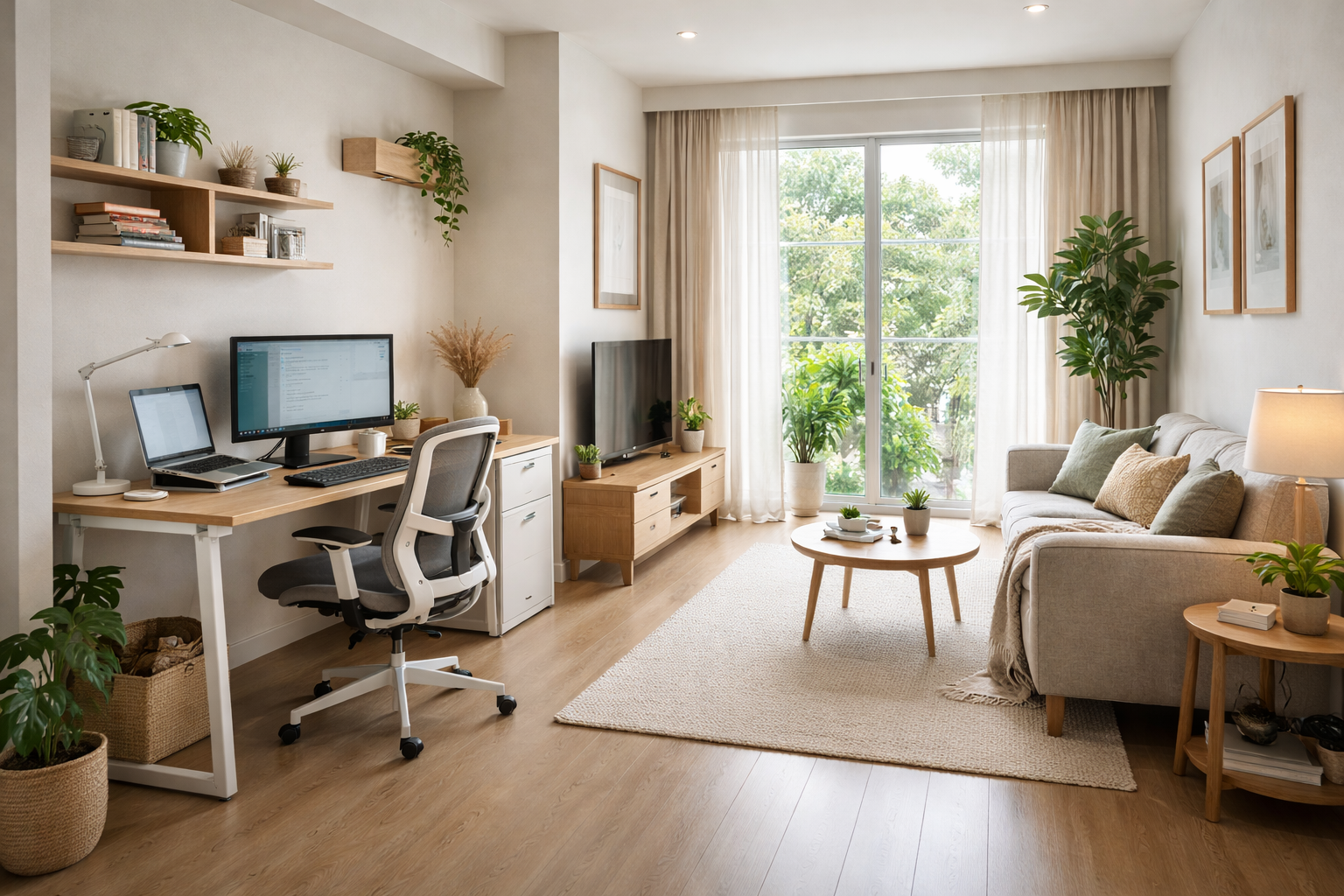
Layout That Actually Works: A Desk Isn’t a Work System
A functional work zone depends on:
- Position: Side daylight from a window beats front glare. Avoid sitting with your back to a door or main walkway.
- Sound buffer: If you’re on calls daily, avoid work desks pressed against shared walls or corridor-facing areas.
- Hidden storage: Visual clutter becomes mental clutter fast in compact spaces.
- Connectivity: Know where your router goes, whether LAN is feasible, and whether your mobile signal is stable in the work spot.
- Cooling reality: If you’ll be home all day, heat exposure matters more than a “nice view.”
Location: Not Just Transit It’s “Life Access”
Hybrid work doesn’t require you to be near transit every day, but it does require frictionless movement when you do need to go out. Aim for a location that keeps city access tolerable (not punishing), while providing real daily essentials nearby: food you actually eat, a supermarket, pharmacy, clinics, and green space for recovery walks.
Also watch what’s coming, not only what’s there now nearby construction can destroy the work-at-home experience for years.
Money Plan: Fly Like a Pilot, Not a Dreamer
The smart plan has three layers:
- Monthly payment that doesn’t choke your life.
- Real savings not “I’ll manage somehow.” Homes create surprise costs.
- Interest-rate stress tests. If your payment only works under a promo rate, you’re exposed.
Thailand’s macro rate environment can shift; there were widely reported policy moves in late 2025 that lowered the policy rate, but your actual mortgage rate depends on bank terms, risk profile, and timing. Plan for volatility, not perfection.
Real Calculation #1 (3.5M THB home, 30 years)
- Price: 3,500,000
- Down: 10%
- Loan: 3,150,000
- Payment estimate at 4%: ~15,000/month
- At 5%: ~16,900/month
- At 6%: ~18,900/month
Real Calculation #2 (5.0M THB home, 30 years)
- Price: 5,000,000
- Down: 10%
- Loan: 4,500,000
- Payment estimate at 4%: ~21,500/month
- At 5%: ~24,100/month
- At 6%: ~26,900/month
These stress tests matter because hybrid work often increases daytime electricity usage, and household costs don’t stay flat across years.
Three Scenarios: Best / Base / Worst
Best-case: Stable rates, rising income, a home that supports deep work and recovery.
Base-case: Rates move, income stays steady, normal repairs appear. You’re fine if you planned for +1%.
Worst-case: Rates jump 1–2%, income pauses for 3–6 months, and a surprise repair bill lands. You survive only if you built a buffer.
A hybrid-work home should be chosen to survive the worst-case, not only to shine in the best-case.
The 0–90 / Transfer Day / 0–90 After Plan
0–30 days: define your real work style (calls vs deep focus, city days per week, noise sensitivity).
31–60 days: visit shortlisted units at multiple times; test sound, heat, light, signal.
61–90 days: finalize finances, document readiness, and full cost list. LTV and lending rules can change by period always verify current bank terms before committing.
Transfer day: don’t rush check meters, keys, condition, agreements.
First 90 days after: build the work setup first, then decoration. Track electricity bills and adjust cooling, curtains, and layout.
10 Common Mistakes (and how to avoid them)
People fail by visiting only once, underestimating heat/noise, ignoring storage, assuming promo rates last, and building “pretty homes” before building a functional work system. The fix is simple: test like a user, not like a viewer and stress test your finances.
Copy-ready Checklist
- Visit at two or more time windows (morning + afternoon or evening + weekend)
- Stand in silence for 3–5 minutes and identify noise sources
- Check afternoon sun exposure where your desk would be
- Test mobile signal and ask about internet providers
- Count outlets and verify cable/route feasibility
- Confirm hidden storage potential (not open shelves only)
- In condos: avoid elevator/trash/mechanical adjacency
- In houses: inspect leak signs, drainage, pests, and real parking
- Separate “work setup budget” from “beauty budget”
- Stress test payments at +1% and +2%
- Keep at least 6 months of essential expenses as buffer
- Plan 0–90 before / transfer day / 0–90 after before paying a deposit